 German
 English
 French

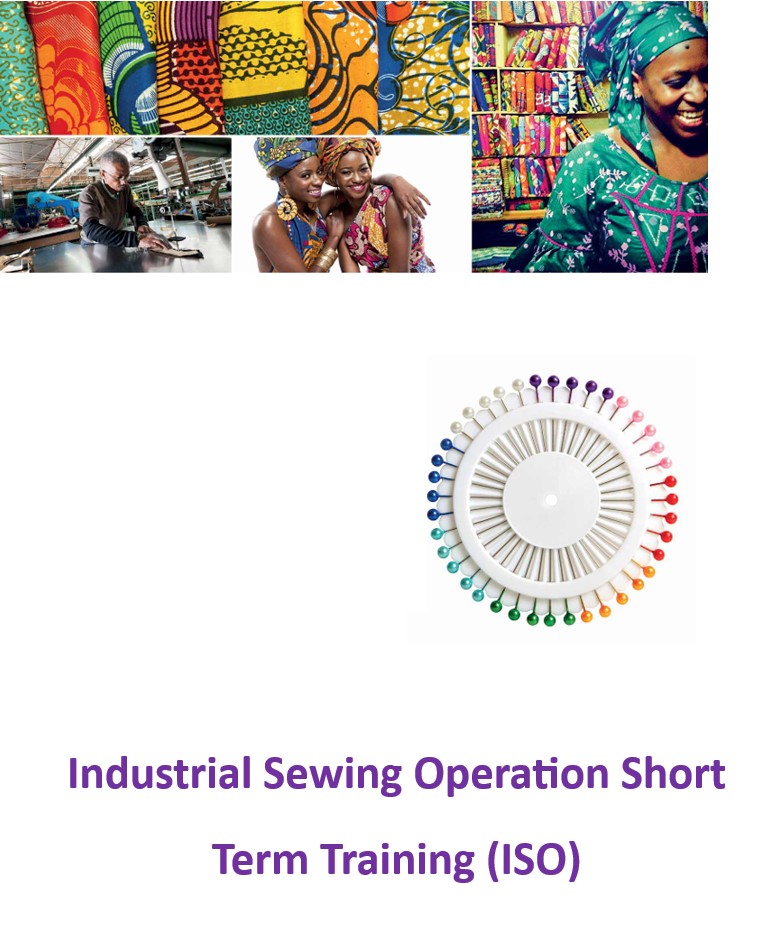
Industrial Sewing Operation Short-Term Training
Executive Summary
The Ethiopian Institute of Textile and Fashion Technology (EiTEX) at Bahir Dar University runs the industry sewing operation Short-Term Training (ISOST) program, a comprehensive program aimed at providing essential Sewing skills to unemployed and underemployed people, especially women, youth, and migrant returnees. This three-month program equips learners with the skills necessary for entry-level jobs in the textile and apparel sector by emphasizing practical training with few theoretical components. From advanced clothing fabrication and sewing machine maintenance to occupational safety and pattern making, the curriculum covers a wide range of competencies. In keeping with Ethiopia's strategic focus on industrial expansion and job creation, entrepreneurship modules also seek to develop trainees' business acumen and cooperative ownership abilities. This program not only deals with regional labor shortages in national level.
Description of The Project
The textile and apparel sector offers ideal conditions to achieve the general and specific objectives of the ASDCoE project. The sector is currently undergoing rapid expansion, driven by the strategic interests of both the Government of Ethiopian (GoE) and key international investors, and it provides significant opportunities for basic technical operators and middle management staff, labor in large factories, and medium and small entrepreneurial activities. In particular, the textile and garment sector is suitable to generate significant employment opportunities for potential migrants and is naturally inclined to attract a significant number of migrant returnee women and youth. The second Ethiopian Growth and Transformation Plan II (GTP II) focuses on the développement of manufacturing industrial parks in different parts of the country. The apparel and textile sector are the first prioritized sector of the strategic plan. In This regard, industrial parks are under implementation by dividing them into different phases and country regions, but getting skilled manpower is the main problem currently challenging the investors for start-ups. On the other hand, job creation and entrepreneurial extension in the selected prioritized sector also correspond to the corresponding goal of the country's growth and transformation plan. Therefore, there is a strong need to promote and support this new and emerging apparel manufacturing sector through training incubation centers. The proposed action has a bilateral benefit for the country's economic growth through the reduction of unemployment among migrant returnees, women, and youth, and poverty alleviation. Firstly, this training incubation center will address the industry's start-up problems by working on the skill development of unemployed youth, women, potential migrants, and returnees in the Amhara region. So that the center serves as a bridge to supply skilled manpower to industrial parks and subsequently reduces unemployment and irregular migration from target areas. Secondly, the training center would boost entrepreneurship in the sector by systematically addressing the issues of lack of skill and training linkages and play a vital role in the sustainable growth of the garment or apparel industry sector.
Goal
¨ Aims to tackle unemployment in Ethiopia's apparel sector while promoting economic growth and long-term job prospects by providing women, jobless youth, and migrant returnees with entrepreneurial and practical clothing-making skills.
Expected Outcome
¨ Proficient Machine Operation: Trainees will confidently set up, thread, operate, and troubleshoot various industrial sewing machines to ensure minimal downtime.
¨ Enhanced Sewing Skills: Participants will develop strong skills in seam formation, stitch quality, and precise material handling, leading to consistent product quality.
¨ Workplace Efficiency: Trainees will learn how to maintain an organized and safe workspace, including proper cleaning and maintenance routines, which contribute to overall productivity.
¨ Quality Control Awareness: The training emphasizes the importance of meeting industry quality standards, resulting in the ability to evaluate finished products for errors and inconsistencies.
¨ Technical Troubleshooting: Operators will acquire a solid foundation in diagnosing common machine issues and applying corrective measures to maintain smooth operations.
¨ Resource and Waste Management: Trainees will be introduced to lean manufacturing principles that help reduce material wastage and optimize resource usage.
¨ Adaptability in Production: The program prepares operators to adjust quickly to varying production requirements and work efficiently in a high-volume manufacturing setting.
Key Competencies for Men’s and Women’s Wear Training
At the end of the course, the trainee should be able to:
1. Understanding basic hand and machine stitches
2. Identify and replace imperfect parts of the sewing machine
3. Perform stich type
4. Practice Basic seam type
5. Perform the necessary alterations on sewing components
6. Practice Cutting, tailoring, and finishing of garments
Table 1: Module Numbers and Courses for Men’s and Women’s wear training
MODULE NAME | Total Hrs. | |
01 | Occupational safety · Introduction to Occupational Safety · Personal Protective Equipment (PPE) · Ergonomics in the Workplace · Emergency Response and First Aid |
4 |
02 | Introduction to Industrial Sewing Machine · Sewing Machine · Domestic Sewing machine and its parts · Industrial Sewing Machine · Treadle Sewing Machine and its parts |
20 |
03 | Sewing Machines Operation · Different Types of Sewing Machines with Technical Details · Types of Industrial Sewing Machine Beds · Tools and special machine operation · Safety and security while handling the tools | 8 |
04 | Seams and Stitches · Seams: Definition · Practice Types of Seams · Practice Top Stitching Seams · Practice Seam with Fullness · Stitch: Definition | 30 |
05 | Garment components preparation · Construct different types of Collars · Construct different types of Cuffs · Construct different types of Pockets · Construct different types of Plackets | 45 |
06 | Work aids Practice · Presser feet · Folders (binders) · Edge guide · Compensating feet | 15 |
07 | Product Development · Marker making and cutting · Skirt sewing · Kids’ dress sewing · Men’s shirt sewing · Men’s trouser sewing · Gown making · Garment finishing (ironing, pressing, and finishing) · Garment costing |
75 |
08 | Workspace Management · Describe safe working practices for the cleaning and maintenance of equipment. · Describe the effects of contamination on products i.e. Machine oil, dirt etc. · Identify different types of cleaning equipment and substances and their use. · Identify different ways of minimizing wastage. | 18 |
09 | Clothing Embroidery · Introduction to Embroidery · Embroidery Tools and Equipment · Hand Embroidery Techniques · Machine Embroidery Techniques · Embroidery Pattern Design and Creation |
15 |
10 | Sewing Machine Maintenance · Introduction to Maintenance · Introduction to Sewing Machine Maintenance · Troubleshooting Common Sewing Machine Problems |
10 |
Total hrs. | 240 | |
Contact Information:
Biniyam Solomon (MSc.)
Dean, Apparel Faculity
Ethiopian Institute of Textile & Fashion Technology (EiTEX)
📧 Email: binik0139@gmail.com
📞 Phone: +251 921 243 999
P.O. Box: 1037
🌐 Website: www.bdu.edu/eitex
Saba Mekonnen (MSc.)
Head, Fashion Engineering Department
Ethiopian Institute of Textile & Fashion Technology (EiTEX)
📧 Email: sabameku7@gmail.com
📞 Phone: +251 923 982 399
 P.O. Box: 1037
🌐 Website: www.bdu.edu/eitex
Niguse Mequanint (MSc.)
Facility Manager (Apparel Faculty)
Ethiopian Institute of Textile & Fashion Technology (EiTEX)
📧 Email: nigusie2112@gmail.com
📞 Phone: +251 918 158 511

P.O. Box: 1037