 English
 French
 German
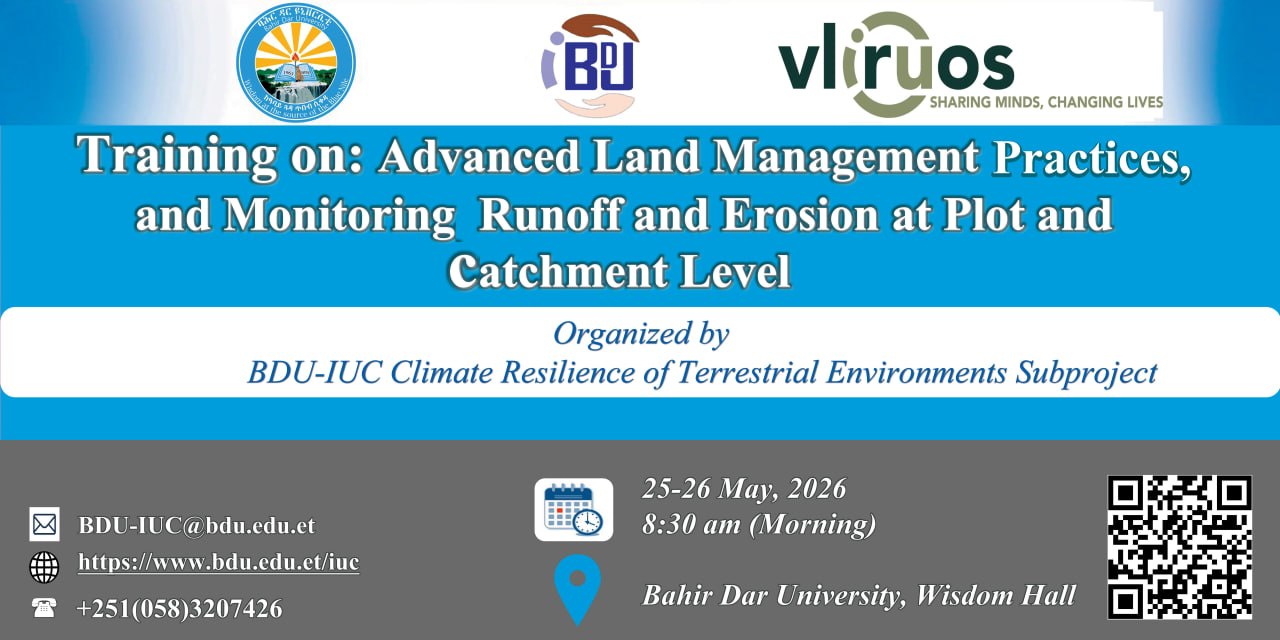
Training on Advanced Land Management Practices, and Monitoring Runoff and Erosion at Plot and Catchment Level
25 May, 2026
The BDU-IUC Climate Resilience of the Terrestrial Environment Subproject is preparing to organise a training event for experts titled "Advanced Land Management Practices and Monitoring Runoff and Erosion at Plot and Catchment Level" on 25-26 May 2026 at Zenzelma Campus, Bahir Dar University.
Introduction
Ethiopia has implemented numerous development programs over the past decades, largely guided by conservation-based agricultural development strategies. Sustainable Land Management (SLM) has therefore remained a national priority, particularly in environmentally sensitive and agriculturally important areas such as the Lake Tana Basin.
The Lake Tana Basin, recognized as a key growth corridor, has benefited from extensive soil and water conservation interventions. These efforts have contributed to improving catchment hydrology, reducing land degradation, and enhancing land productivity. Physical conservation measures such as stone bunds and soil bunds have played a significant role in reducing sheet and rill erosion on croplands.
However, evidence from Phase I research under the BDU–IUC Climate Resilience of Terrestrial Environment Sub-Project (SP2) indicates that the success of these interventions has been uneven. In particular, gully erosion has emerged as a critical challenge, contributing significantly to sediment yield and undermining gains made through conventional soil conservation practices. The persistence and expansion of gullies highlight the need to reorient land management strategies toward gully stabilization and rehabilitation.
The findings further emphasize that:
- Gully bank failure is strongly influenced by runoff concentration and improper drainage systems
- Biological measures, particularly vegetation cover, are more effective in reducing soil loss than physical structures alone
- Some check dam designs may aggravate gully erosion
- Integration of physical and biological approaches is essential for sustainable outcomes
- Practices such as grass strips along gully banks and improved agronomic measures (e.g., crop residue management) need greater attention
Despite the availability of these important research insights, there remains a gap between research outputs and their practical application. This training workshop is therefore designed to bridge that gap by sharing evidence-based knowledge with key stakeholders and promoting actionable solutions.
The training aligns with Bahir Dar University’s commitment to supporting evidence-based policy, environmental sustainability, and community engagement.
Overall Objective
To disseminate Phase I research findings and strengthen stakeholders’ capacity to implement effective, sustainable land management practices, with a focus on gully erosion control and land rehabilitation.
Specific Objectives
- To present key research findings on soil erosion dynamics and gully formation in the Lake Tana Basin
- To enhance stakeholders’ understanding of gully erosion control and stabilization techniques
- To promote the integration of biological and physical land management measures
- To raise awareness of effective soil and water conservation practices
- To facilitate dialogue between researchers, policymakers, and practitioners
- To strengthen collaboration among institutions involved in land management
- To support the use of research-based evidence in planning and decision-making
Expected Outputs
The workshop is expected to generate:
- Improved understanding of sustainable land management challenges and solutions
- Increased awareness of the importance of gully erosion control
- Identification of best practices and scalable interventions
- Strengthened collaboration among stakeholders and institutions
- Development of practical recommendations and action plans
- A simple and cost-effective check dam design is promoted
- Enhanced linkage between research, policy, and field implementation
Methodology
The training will employ a participatory and interactive approach, including:
- Presentations by researchers and experts
- Discussions on key SLM issues
- Group discussions and stakeholder experience sharing
- Case studies and practical examples
- Plenary sessions for feedback and synthesis