 English
 French
 German
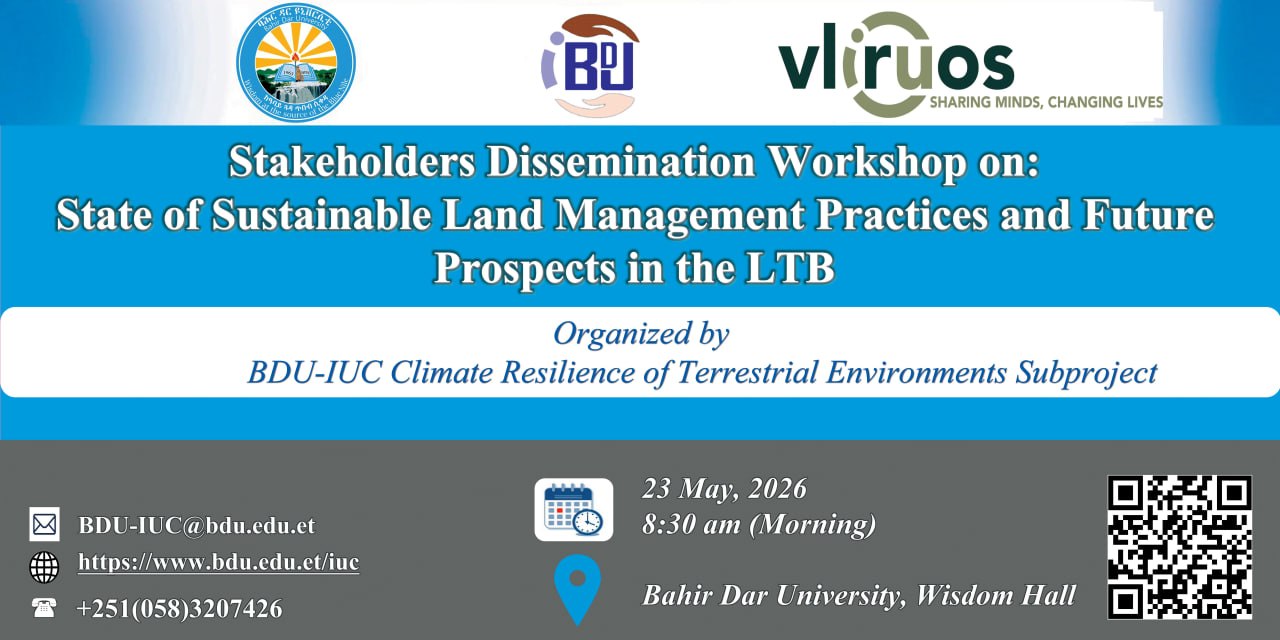
Promoting Sustainable Land Management Practices: the experience of BDU-IUC Climate Resilience of Terrestrial Environment Subproject research outcomes
Wisdom Hall, Bahir Dar University
23 May, 2026
The BDU-IUC Climate Resilience of Terrestrial Environment Subproject will host a stakeholders' dissemination workshop titled "Promoting Sustainable Land Management Practices" (The Experience of BDU-IUC SP2 Research Outcomes) on 23 May 2026 at Wisdom Hall, Bahir Dar University.
Introduction
Land degradation, particularly soil erosion, is one of the critical challenges for ensuring sustainable development in Ethiopia. The average annual sediment yield that goes out of Ethiopia is estimated between 2-3 billion tones. Consequently, productive agricultural areas become degraded lands and agricultural productivity remain at its lowest margine in most parts of the country. This problem has been exacerbated recently coupled with climate change effects lingering frequent droughts, environmental disasters and famine. To overcome this bottleneck, Ethiopia has gone through a number of development programs in the last decades. Recently, the government of Ethiopia has embarked on an ambitious initiative (The Green Legacy Initiative) and enacted a legislation that supports the landscape restoration and green legacy initiative activities. Hence, sustainable land management has been one of the top priorities of the government. As an important growth corridor, the Lake Tana Basin has received a great deal of those interventions which had a significant role on the catchment hydrology and erosion processes, and contributed significantly to enhance land resilience.
The Land Resilience Sub-Project under Phase I of the BDU–IUC partnership program was designed to generate scientific evidence and practical solutions addressing prevalent environmental challenges related with land management and resilience to climate change in the Lake Tana basin. The sub-project explored key thematic areas including catchment runoff and sediment yield, ecosystem services of remnant church forests in the basin and tracing riverside sediment disposition history.
As part of one of the research activities of this sub-project, runoff and soil loss have been studied at zero-order catchments (at single land use level), catchment discharge, sediment yield and gully erosion have been studied at small catchments. The results show that the soil and water conservation efforts in general have had a tremendous impact in rehabilitating degraded areas and reducing the rate of soil erosion in croplands, though the problem is still prevalent. Stone bunds and soil bunds are the most widely practiced soil and water conservation structures on steep slope cropland areas. Those efforts have significantly reduced sheet and rill erosion; yet current rate of soil loss is still above the soil loss tolerance limit in croplands. Besides, the the rate of gully erosion is high, compromising the successes on the overland erosion. Some sustainable land management practices such as the use of rock fragments for stone bunds, and inappropriate check dam designs may exacerbate the problem.
The dissemination of research outputs from the first phase of the BDU–IUC project is a critical step toward translating academic findings into actionable knowledge and community impact. Despite the availability of rich data and innovative research results, gaps often persist between research and implementation, particularly in decision-making and community engagement processes.
This workshop is therefore planned to share the research findings of the Land Resilience Sub-project theme of the BDU-IUC program to relevant stakeholders to further enhance our collective understanding on the current state of soil erosion processes in the Lake Tana basin, and support the sustainable land management efforts with evidence-based practices.
Moreover, the workshop aligns with Bahir Dar University’s strategic commitment to evidence-driven policy support, community engagement, and capacity development. It also reinforces the project’s broader mission to promote sustainable livelihood systems through participatory research, environmental conservation, and responsible use of natural resources.
Given the growing urbanization and tourism potential in the Lake Tana region, it is essential to equip decision-makers and local actors with practical knowledge on: Integrating sustainable geotourism into local development planning; and Enhancing livelihood resilience through sustainable natural resource management.
Objectives of the Workshop
- To enhance collective understanding of the relevant stakeholders on current state of land degradation in the Lake Tana basin that emanates from soil erosion.
- To highlight to what extent the sustainable land management practices implemented for the last decades were effective in reducing soil erosion.
- To show some ill practices of sustainable land management that have rather aggravating effects.
- To promote a low cost and simple method of monitoring farm level (zero order catchment) runoff and soil loss
- To share the thresholds for ensuring sustainable land management (what level of soil loss should be tolerated at farm level)
- To show a direction where the focus of sustainable land management should be
- To showcase the potential role of BDU in the effort for ensuring sustainable development and strengthen its collaboration with stakeholders and communities.
Expected Outputs of the Workshop
The workshop will generate actionable knowledge, foster collaboration, and enhance evidence-based decision-making. The main expected outputs include:
- There will be enhanced understanding among the different stakeholders on the current state of soil erosion in the Lake Tana basin.
- Practitioners will get better insight on the impacts of sustainable land management practices implemented so far.
- Participants will have better understanding on some inappropriate sustainable land management practices that rather aggravate soil erosion.
- Participants will learn a simple innovative method of measuring runoff and sediment loss at farm level.
- There will be a common understanding on most critical form of soil erosion that should be focused on (prioritized), while taking measures of sustainable land management.
- There will be an integrated effort and shared responsibility among the different stakeholders on reducing soil erosion and ensuring sustainable development.