 English
 French
 German

Curriculum Evaluation and Revision and Training in Innovative Pedagogies
BDU APPEAR
10 Sep, 2026

Curriculum Evaluation and Revision and Training in Innovative Pedagogies
The project aims to advancing agroecology at Bahir Dar University and community research in the Amhara region in Ethiopia. The second reporting period from 1 May 2025 – 30 April 2026 marked the successful delivery of major project milestones across curriculum development, practical field implementation and institutional capacity building, especially in teachers training.
A core achievement of this project period of “Establishing Transformative Learning, Research and Community Outreach and Capacities in Agroecology at Bahir Dar University, Ethiopia | LINK” was the completion of the evaluation of the MSc in Agroforestry curriculum. Implemented jointly by Bahir Dar University (BDU) and the University College for Agrarian and Environmental Pedagogy (HAUP), the updated curriculum integrates transformative, learner-centred didactical approaches and explicitly embeds gender and accessibility considerations into its structure and is based on the needs and demands of the (external) stakeholder gathered in a consultative process.
To support its implementation and individual module improvements, academic staff from BDU and partner institutions engaged in virtual and hybrid training series. These sessions introduced frameworks such as Green Pedagogy, Transformative Learning approaches and the Synoptic Transfer Framework (STF)—a model designed to bridge Western scientific paradigms with local, indigenous farming knowledge. Workshop outputs are currently being compiled into a practical teaching manual to serve as a lasting resource for BDU teachers. In parallel, program admission criteria were finalised and priority research themes were established to guide upcoming graduate theses toward pressing regional socio-ecological real-world challenges.
Field Implementation and Action Research
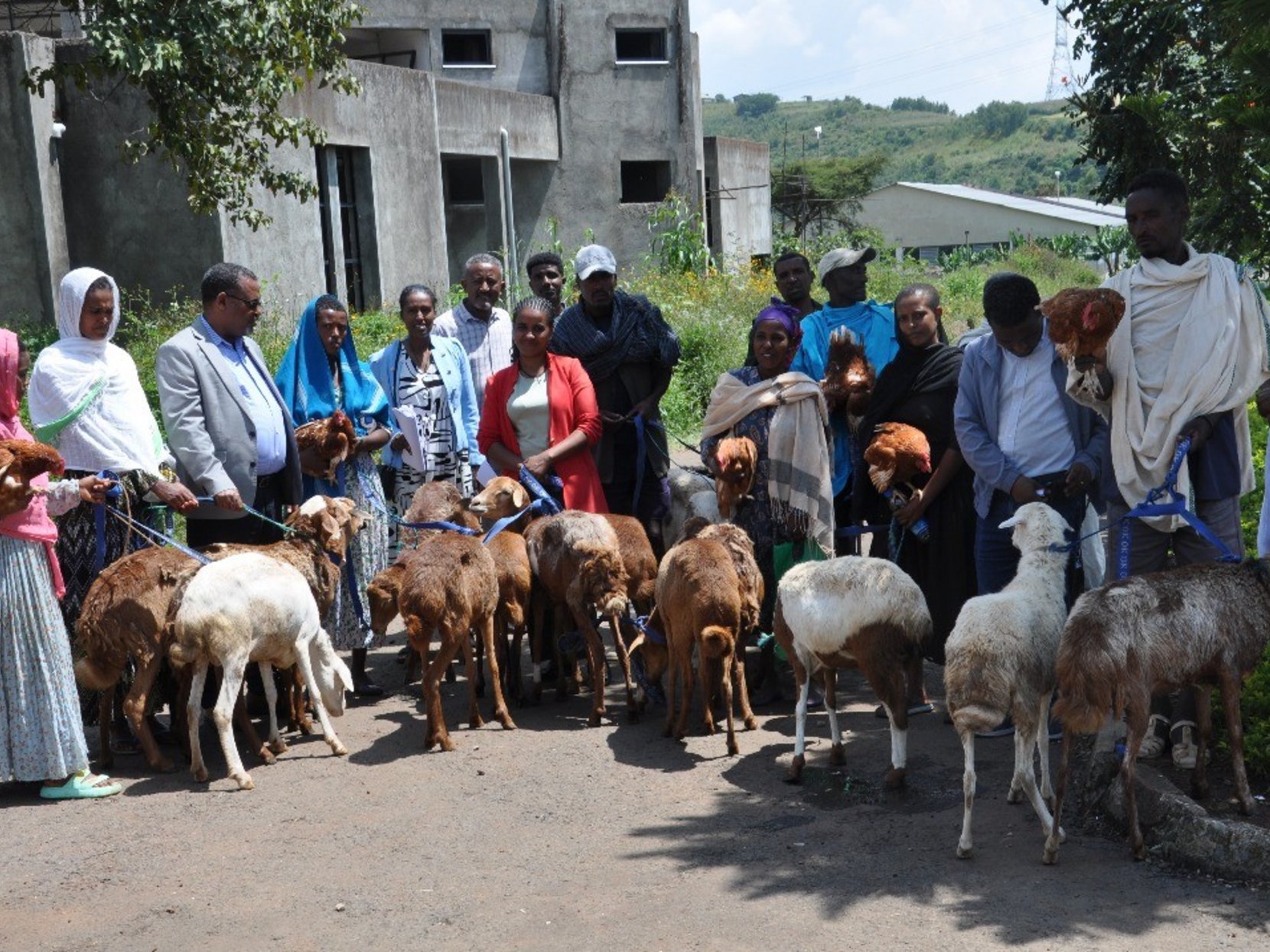
On the ground, practical progress was made the establishment of the Agroecology Demonstration Site and the further operationalisation of Farmer Family Learning Groups (FFLGs). The project targeted resource-constrained households in Mogedel Village—selecting ten members, including six women and one participant with a disability—act as lead farmers and to receive agroecological inputs, seedlings, livestock and ongoing agroecological extension advisory.
These beneficiary homesteads now function as active learning sites. Beyond improving household nutrition and income, they provide BDU students and researchers with practical platforms for field exercises, collaborative monitoring and participatory action research.
Institutional Capacity and Stakeholder Integration
To strengthen (action) research on Agroecology at BDU a weekly seminar program was introduced at the Department of Natural Resources Management and conducted staff capacity-building trainings covering research methodologies and academic English. Additionally, a tracer study of program graduates was completed to evaluate labour market alignment and refine the curriculum revision process. Regional and international networking remained central. The project successfully convened its 2nd and 3rd Stakeholder Platform Workshops, bringing together over 70 representatives from government agencies, research institutes (ARARI, EFD), civil society (World Vision Ethiopia) and regional academic bodies. These workshops validated the curriculum, reviewed project performance and established a shared action plan for the next project phase.
Enrollment of Students in Agroforestry Program
In October 2025 four students have officially enrolled in the Agroforestry program under the revised Agroforestry curriculum at Bahir Dar University, marking an important milestone in strengthening education and professional capacity in agroforestry in Ethiopia.
The enrollment represents the first group of students to join the program following the revision and updating of its curriculum. The revised curriculum is designed to provide students with more relevant and practical knowledge and skills in agroforestry, integrating contemporary approaches to sustainable land management, indigenous knowledge, climate change adaptation, biodiversity conservation, soil and water management, and sustainable livelihoods.
Through the updated program, students will have opportunities to develop both theoretical understanding and practical competencies needed to address the growing challenges facing agricultural landscapes and natural resources. The program also seeks to strengthen the connection between academic learning, research, innovation, and community-based agroforestry practices.
The enrollment of the four students is therefore an important step toward building a new generation of professionals capable of contributing to sustainable and climate-resilient agricultural development through agroforestry.